Saturday, July 19, 2014

Gaza: This Shameful Media Coverage Part III

Hard as it is to believe, we've now reached the most objectionable portion of Milne's screed.  In it, he denies all Israeli right to self defense as a matter of principle - regardless of what actions Palestinians take against Israel, and regardless of what form that self-defense might take - and hopes for the day that Palestinian groups can cause mass Israeli casualties.

No, I'm not joking.
The idea that Israel is defending itself against unprovoked attacks from outside its borders is an absurdity. Despite Israel’s withdrawal of settlements and bases in 2005, Gaza remains occupied both in reality and international law, its border, coastal waters, resources, airspace and power supply controlled by Israel.
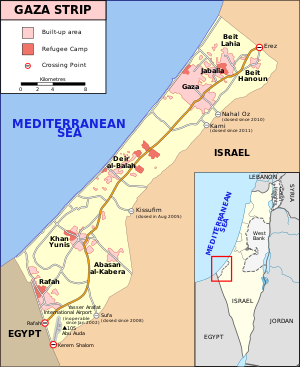
 We've addressed this contention before, but let's do it again.  Israel is not occupying Gaza.  There is not a single Israeli citizen living in Gaza.  Until Israel launched the ground phase of Protective Edge on July 17, 2014, there wasn't a single Israeli soldier in Gaza, and after the operation is concluded, there won't be a single Israeli soldier remaining in Gaza.  The Palestinians - in the form of their elected Hamas government - administrate the territory, making and enforcing its laws and policing it.

These aren't "fun facts."  They conclusively refute any argument that Gaza is occupied by Israel, because "occupation" is a term with a well defined meaning in international law.  But don't take my word for it - listen to the International Committee of the Red Cross:
1. What is occupation?
Article 42 of the 1907 Hague Regulations (HR) states that a "territory is considered occupied when it is actually placed under the authority of the hostile army. The occupation extends only to the territory where such authority has been established and can be exercised." According to their common Article 2, the four Geneva Conventions of 1949 apply to any territory occupied during international hostilities. They also apply in situations where the occupation of state territory meets with no armed resistance. ...

2. When does the law of occupation start to apply? 

The rules of international humanitarian law relevant to occupied territories become applicable whenever territory comes under the effective control of hostile foreign armed forces, even if the occupation meets no armed resistance and there is no fighting.

The question of "control" calls up at least two different interpretations. It could be taken to mean that a situation of occupation exists whenever a party to a conflict exercises some level of authority or control within foreign territory. So, for example, advancing troops could be considered bound by the law of occupation already during the invasion phase of hostilities. This is the approach suggested in the ICRC's Commentary to the Fourth Geneva Convention (1958).

An alternative and more restrictive approach would be to say that a situation of occupation exists only once a party to a conflict is in a position to exercise sufficient authority over enemy territory to enable it to discharge all of the duties imposed by the law of occupation. This approach is adopted by a number of military manuals.
 In other words, "occupation" is defined by actual control of territory, on the ground.  In the most expansive interpretation, the law of occupation applies to territory in which an invading army has boots on the ground.  Alternatively, it applies only where the occupier has sufficient control over the territory to exercise all duties of an occupier.  

The more expansive interpretation makes more sense to me, so long as the duties of occupation apply in that case only to the extent that the occupier can actually fulfill them; it makes no sense to impose a duty to police, for example, on an invading army without sufficient control to do so effectively.  But whatever definition you prefer, note what is not on the list of criteria for defining the beginning of an occupation: any of the factors cited by Milne.  

Control of coastal waters?  No.  By that definition, any blockade constitutes an occupation, and that isn't the law.  Moreover, even were that considered occupation of Gaza's coastal waters, and even under the expansive interpretation of the Red Cross, an "occupying power" that "occupied the coastal waters" would only have the duties of an occupier with regard to those coastal waters.

The same goes for the rest of Milne's list.  The Gaza skies?  By that definition, the U.S., U.K., France, Turkey occupied Iraq from 1991-2003, and the UN Security Council occupied Bosnia and Herzegovina from 1993-1995 when they imposed no-fly zones there.  

Gaza's borders?  For one thing, Israel doesn't control Gaza's borders.  Gaza has three borders: north, east, and south (it's western edge is the Mediterranean).  It shares its northern and eastern borders with Israel, true - but its southern border is with Egypt, not Israel.  Egypt is a sovereign state that controls its border with Gaza as it chooses, opening and closing the Rafah crossing on its own authority, and mostly keeping it closed since Hamas' violent take-over of the Palestinian side of the crossing, and subsequent attack on Egypt's border patrol and fence.

Which brings us to a more fundamental point - in what universe does a state's decision to close its borders to a neighboring state create an "occupation"?  Set aside the reason why Israel and Egypt each closed their borders to Gaza - that Hamas used transit over those borders to arm for and commit terrorist assaults on Israel and Egypt.  The fact remains that as sovereign states, Israel and Egypt are entitled to operate their own borders as they please.  Closing the border with a neighboring state does not create a state of occupation.

The same goes for control of resources and power supply.  Again, set aside the question of whether Israel actually controls either (Gazans are free to exploit their own natural resources and build their own powerstations, but the Hamas rulers of the strip have turned their attention to more important things, like building tunnels and launching rockets).  There's just no basis in international law to consider "control of resources and power supply" from outside of a territory the occupation of that territory.

So no, in reality and international law, Gaza is not occupied by Israel.  It is certainly in a state of open war with Israel, and blockaded by Israel - but it isn't occupied.  It's important to keep that in mind given what's coming next.
So the Palestinians of Gaza are an occupied people, like those in the West Bank, who have the right to resist, by force if they choose – though not deliberately to target civilians.
Again, set aside that Milne is (as I've shown) simply wrong about the status of Gaza as an occupied territory.  What is the point of stating that "the Palestinians of Gaza have the right to resist by force, so long as they do not deliberately target civilians" when the fact is that Palestinian "resistance" is comprised almost exclusively of deliberately targeting civilians?  And, as Palestinian UN Human Rights Council delegate Ibrahim Khreisheh noted, when the rocket attacks coming from Gaza at the moment deliberately target civilians?  And when Hamas openly says that all Israeli citizens are its "legal targets"?

By his own thesis, then, Milne agrees that the Palestinians have no right to "resist" in the manner that they have chosen.  That should be an important point, one he would be expected to make explicitly, and take to heart.  But to Milne, it's irrelevant - because ...

But Israel does not have a right of self-defence over territories it illegally occupies – it has an obligation to withdraw.
Let that marinate for a bit. Israel does not have a right to self defense.

It's actually a bit refreshing to have someone from the anti-Israel brigade come out and say expressly what has, for a long time, been the obvious and unstated premise behind opposition to Israel's defensive actions over the years: Israel has no right to self defense.

As such, it doesn't matter what Israel is defending against.  Suicide bombers in its cafes and houses of worship, kidnap and murder of its children, rockets aimed at its cities, or sharks with fricken laser beams attached to their fricken heads - it's irrelevant.  Israel has no moral right to defend itself; its only option is to sit back and take whatever punishment its enemies choose to dish out.

This is a breathtaking claim.  In all but the most partisan Palestinian shills, it generates visceral repugnance and rejection - which is why it's so rarely expressed outright, as Milne does here.  So what evidence supports Milne's position?

Well, his link takes us to Jadaliyya.com, an ezine published by the Arab Studies Institute, and an article penned by "Palestinian American human rights attorney and activist" Noura Erekat. Erekat has a law degree from Berkley and an L.L.M. from Georgetown, impressive credentials.  She helped launch the BDS movement and has written in favor of academic boycotts against Israeli institutions, and rejects the entire concept of "two states for two peoples" and advocates for a "One [Palestinian] State solution."  So it's not really surprising that she would take an extreme anti-Israel position.  But does it have merit?

In a word: No.

The right to use military force in self-defense is enshrined in Article 51 of the UN Charter, which provides as follows:
Nothing in the present Charter shall impair the inherent right of individual or collective self-defence if an armed attack occurs against a Member of the United Nations, until the Security Council has taken measures necessary to maintain international peace and security.
This is about as express as can be: a member of the United Nations (which Israel is) has an "inherent right" of self-defense in response to "an armed attack" against it.

Given that rocket launches obviously qualify as an "armed attack," how does Erekat get around this?  Here is the basis of her argument:
"A state cannot simultaneously exercise control over territory it occupies and militarily attack that territory on the claim that it is “foreign” and poses an exogenous national security threat."
Erekat hypothesizes, essentially, that Israeli claims to a legal right of self defense are self-contradictory given its status as an occupier of Gaza; an "occupier" with duties to protect the civilians of the occupied territory cannot "militarily attack" that territory.  She builds her argument in a fairly straightforward way:

1) Occupying powers have a right and duty to police the occupied territory, and policing powers are more limited than military force allowed in self defense; policing powers include the right to use lethal force, but only as a last resort, and as limited by concern for non-combatants;
2) Self defense when attacked is what's known in international law as jus ad bellum - just cause to "begin to fight" by declaring war and respond militarily.  This is distinguished from jus in bellum - just methods of fighting (i.e. the rules governing the conduct of war, such as principles of distinction [targeting combatants rather than civilians] and proportionality [attacking only where doing so is justified by sufficient military gain])

 3) Since the occupation of a territory means that an armed attack "has already occurred and been concluded," and there can be no right to "begin" a fight that has already concluded

None of these arguments hold water, for a number of reasons.

First, as noted above, Gaza is not occupied territory in the first instance.  But even if Gaza were occupied territory, it can only be occupied under the expansive definition preferred by the Red Cross: that some portion of Gaza's territory is under Israel's effective control.  But the Red Cross' definition only obligates an "occupier" in that limited sense to exercise the obligations it can effectively carry out, and only in the area it actually controls.  More, that definition of "occupation" clearly does not prohibit the use of military force in response to military attack, since - by its own terms - the definition applies to an army mid-invasion.  It would be entirely absurd to argue that an invading army has no right to respond militarily to a military attack on it.  (It's worth pointing out here that not all invasions are illegal or immoral; the Allies, for example, invaded Germany, Japan, and Italy during WWII).

In other words, even assuming Erekat is right about everything else, any restraints on Israel's right to use military force in self-defense are limited to Gaza's air space and coastal waters (the areas Israel controls) and those parts of Gaza in which Israel is able to effectively police (i.e. exactly nowhere), and don't apply to responses to military attack.  That would impose no limit at all on the right to use military force in response to rocket attacks from Gaza.

Second, Erekat concedes that military force can be used by an occupying power in policing, where absolutely necessary and with appropriate concern for non-combatants.  Since that is what Israel is doing, her entire argument is a non-issue.  (Indeed, as Peter Berkowitz has pointed out in the context of an earlier operation, the amount of force Israel would need to use to "police" Gaza and "arrest" Hamas fighters is a full scale invasion of and recapture of Gaza, complete with house-to-house fighting.  That would make Israel's current operation seem like a pillow fight - and Erekat's argument thus becomes that Israel is "limited" to using vastly more force than it has actually deployed, which makes it somewhat less than persuasive as an argument that Israel's current actions are illegal.  Berkowitz' article is a longer, better written point by point refutation of Erekat, and deserves a read in its own right).  

Third the notion that Israel's military action in Gaza had "already concluded" once it occupied Gaza is absurd.  Again, the self-same expansive Red Cross definition that Erekat must accept to consider Gaza occupied contradicts that claim.  Under the Red Cross definition, an advancing army occupies any territory it controls, even if hostilities are ongoing.  In other words, a state of occupation, under the Red Cross definition, does not exclude the possibility of continuing military action and continued use of military force.  Erekat is, of course, free to reject the Red Cross definition of "effective control" - but the alternative, which applies only if Israel is in position to exercise all of the duties of an occupier, only makes more clear that Gaza is not occupied territory.  So that doesn't help her much.

In other words: Yes, Virginia, Israel's right to self-defense does exist.

(Side note: Erekat also relies on the ICJ's 2004 advisory opinion on the separation fence, which held that Article 51 rights of self-defense do not apply to non-state actors.  There are three problems with that.  First, the decision was simply wrong; the UN Charter does not say that self-defense applies only to attacks by other states, and the ICJ's limitation of the right of self-defense to attacks by state actors (at page 121) provided no reasoning or discussion of how they read the phrase "attack by another state" into the Charter.  

Second, though that statement appears in the main decision, not all of the judges who agreed with the overall judgement agreed with that portion of it.  For instance, Judge Higgins wrote that he did "not agree with all that the Court has to say on the question of the law of self defense."  Judge Kooijmans disagreed as well.  Judge Buergenthal (who did not concur in the judgement) emphatically and persuasively rejected it.

Third, and most fundamentally, since the ICJ issued its opinion: (1) Israel withdrew from Gaza; (2) Hamas became the government of Gaza and a party to the unity government of Palestine; and (3) Palestine was admitted to the UN as an observer state.  In other words, the idea that Hamas are "non-state actors" is simply no longer true at all.)

Back to Milne - and the second half of that obscene sentence:
it has an obligation to withdraw.
No.  No it doesn't.  Security Council resolution 242 requires Israel to withdraw only from "territories" occupied in 1967, not "all the territories" - language included in and specifically rejected from a prior draft of the resolution.  More importantly, 242 frames any Israeli obligation to withdraw as conditional and coextensive with an obligation on the Palestinians (and other Middle East states) to cease making war on Israel.  Until the Palestinians are ready to make peace, Israel has no legal obligation to withdraw.  And even as it signed its unity agreement with Mahmoud Abbas, Hamas expressly rejected the very notion of peace with or recognition of Israel.  So no, Israel does not have any obligation to withdraw.


That occupation, underpinned by the US and its allies, is now entering its 48th year. Most of the 1.8 million Palestinians enduring continuous bombardment in Gaza are themselves refugees or their descendants, who were driven out or fled from cities such as Jaffa 66 years ago when Israel was established.
It can’t seriously be argued that Israel’s refusal to withdraw from the rump of the territory on which the United Nations voted to establish a Palestinian state in 1947 is because of rocket fire. It was after all during the period of quiescence over the past year that the Israeli government rejected the US plan for even a figleaf of a two-state solution – and stepped up illegal colonisation. As Netanyahu made clear this week, there cannot be “any agreement in which we relinquish security control” of the West Bank.
Again, set aside the error about occupation, and Milne still has this all wrong.  The "period of quiescence" Milne refers to still involved the launch of over 100 rockets at Israel, the kidnapping and murder of Eyal, Gilad, and Naftali, 300 separate attacks on Israelis in October and November 2013, including an attempted bus bombing, etc., etc.  That this can be truthfully referred to as a "period of quiescence" - and it is, in comparison to the terror war of the early 2000s - is a sad commentary on what Israel expects from the Palestinians.  The notion that hundreds of attacks on Israeli civilians ought to leave Israel's government unconcerned about security, on the other hand, isn't sad.  It's delusional.
So we’re left with a one-state solution, operated on ethnically segregated apartheid-style lines, in which a large section of the population has no say in who rules over them, indefinitely. But it’s folly to imagine that this shameful injustice will continue without an escalating cost for those who enforce it.
I'm not going to bother responding to the apartheid slur, which could take a whole other article, beyond noting the presence in Israel's parliament of Hanin Zoabi, an Israeli Arab who recently penned an article on a Hamas website that encouraging attacks on the State in which she serves as an MP.  The more fundamental point is this: Israel has offered the Palestinians a state multiple times: at Camp David, at Taba, and the Olmert proposal. The Palestinians rejected each of these offers.  The Palestinians could have had a state for over a decade now; Arafat chose war instead. 
Palestinian resistance is often criticised as futile given the grotesque power imbalance between the two sides. But Hamas, which attracts support more for its defiance than its Islamism, has been strengthened by the events of the past week, as it has shown it can hit back across Israel – while Abbas, dependent on an imploded “peace process”, has been weakened still further.
This is nonsense, for a couple of reasons.  First, Palestinian "resistance" isn't typically criticized for its futility, but for its immorality - its deliberate attacks on Israeli civilians, the murder of children, celebration of death, and open anti-Semitism.

As for "strengthening Hamas" - at the moment, Hamas has shown that it can kill a grand total of two Israelis, while bringing down untold destruction on Gaza.  It is being lambasted in the wider Arab world, with Egyptian commentators describing them as "delusional" and expressly rejecting sympathy for Gaza so long as Hamas remains in power; Syrian and Saudi writers are piling on as well.

In fact, the only place Hamas seems to be receiving more support is . . . well . . . in Europe, from folks like Milne.
The conflict’s eruptions are certainly coming thicker and faster. Despite heroic Israeli efforts to fix the narrative, global opinion has never been more sympathetic to the Palestinian cause. But the brutal reality is that there will be no end to Israel’s occupation until Palestinians and their supporters are able to raise its price to the occupier, in one way or another – and change the balance of power on the ground.
Did you catch that?  The way to peace in the Middle East is to create more Israeli civilian casualties and better arm the terrorists looking to cause them.  On this disgusting notion, no further comment is necessary.

In sum, Milne's piece is utter garbage, from start - the very first sentence! - to finish.  It is contemptuous of facts, of international law, and of human life.  It should never have been published - but having been published, it may actually do some good, by laying bare the true face of the anti-Israel crowd.

Here's hoping.


Friday, July 18, 2014

Gaza: This Shameful Media Coverage, Part II

Picking up where we left off: 
So far, Palestinian fire has killed one Israeli on the other side of the barrier that makes blockaded Gaza the world’s largest open-air prison.
But instead of demanding a halt to Israel’s campaign of collective punishment against what is still illegally occupied territory, the western powers have blamed the victims for fighting back. If it weren’t for Hamas’s rockets fired out of Gaza’s giant holding pen, they insist, all of this bloodletting would end.
We've already talked about the blockade in Part I.  But it's worth pointing out three things.  

First, the absurdity and ignorance of the suggestion that a naval blockade that has actually prevented more powerful arms from reaching Hamas is "collective punishment" (which is illegal under international law).  International law clearly and expressly allows blockades, particularly to prevent weapons from reaching a belligerent.  And by definition, blockades operate over a territory as a whole, and are not limited to combatants within that territory.  So as a matter of international law, blockades (which are legal) are not collective punishment (which is illegal).  Unless Milne wants to suggest that Israel could effectively blockade only combatants - perhaps Hamas members would be kind enough to allow themselves to be surrounded at all times by their own mini-cordon of IDF soldiers to prevent them from obtaining weapons? - the blockade of Gaza is not collective punishment. 

Second, the insanity of suggesting that Israel ought to be or even could be pressured to lift the blockade (which is one of Hamas' "conditions" for a cease fire).  Right now, the blockade is combining with Iron Dome to prevent Hamas from being able to kill Israeli civilians.  Open the door to Hamas receiving weapons shipments from Iran - which is what lifting the blockade would do - would dramatically increase the likelihood of Hamas achieving the massacre of Israeli civilians that it has been trying for and openly advocating.  Israel isn't going to commit suicide, and folks like Milne who are hoping for that are doomed to disappointment.

Third, and most fundamentally, Milne's sneer that ending the rocket fire would not end "all of this bloodletting" runs smack into the hardest contradiction of all: incontrovertable facts.  Israel has now twice accepted cease-fire proposals and actually ceased its fire the first time while waiting for word from Hamas that it, too, would cease firing.  Israel only resumed firing when Hamas rejected the cease fire proposals.  

In other words, "[i]f it weren't for Hamas' rockets fired out of Gaza," then "all this bloodletting would [have already] end[ed]."  
“No country on earth would tolerate missiles raining down on its citizens from outside its borders,” Barack Obama declared, echoed by a mostly pliant media.
Mostly because its true.  Indeed, while bristling at the President's comments, not even Milne can bring himself to suggest that President Obama was wrong.
Perhaps it’s scarcely surprising that states which have themselves invaded and occupied a string of Arab and Muslim countries in the past decade should take the side of another occupier they fund and arm to the hilt.
 Yes.  States like Egypt, notorious for "invad[ing] and occup[ying] a string of Arab and Muslim countries" and for "fund[ing] and arm[ing] Israel."  Notoriously anti-Palestinian, pro-Israeli statesmen like . . . Palestinian President Mahmoud Abbas, and Palestinian UN Human Rights Council representative Ibrahim Khreisheh.

Abbas had this to say to Hamas: "What are you trying to achieve by sending rockets?"  And Khreisheh was candid in acknowledging both Israel's efforts to warn civilians and that Hamas' rocket attacks on Israel are war crimes:
I am not a candidate in any Palestinian election, so I don't need to win popularity among the Palestinians.  The missiles that are now being launched against Israel - each and every missile constitutes a crime against humanity, whether it hits or misses, because it is directed at civilian targets.  What Israel does against Palestinian civilians also constitutes crimes against humanity.  With regard to crimes of war under the Fourth Geneva Convention, the settlements, the checkpoints, the Judaization, the arrests, and so on, we find ourselves on very solid ground.  However, there is a Palestinian weakness with regard to the other issue.  Therefore, targeting civilians - be it one civilian or a thousand - is considered a crime against humanity.  ... Please note that many of our people in Gaza appeared on TV and said that the Israeli army warned them to evacuate their homes before the bombardment.  In such a case, if someone is killed, the law considers it a mistake, rather than intentional killing ...  Therefore, people should know more before they talk emotionally about appealing to the ICC. [Translation from Arabic by MEMRI]
Somehow, Milne's criticism that President Obama isn't "more Palestinian than the Palestinians" on this issue doesn't seem all that persuasive.  But maybe that's just me?

Back to Milne:
But the idea that Israel is responding to a hail of rockets out of a clear blue sky takes “narrative framing” beyond the realm of fantasy. In fact, after the deal that ended Israel’s last assault on Gaza in 2012, rocketing from Gaza fell to its lowest level for 12 years.
Again, there are multiple things worth pointing out here.

First, Milne's point that "rocketing from Gaza fell to its lowest level for 12 years" after the last Gaza war directly contradicts those who argue that the use of military force in Gaza is pointless.  To the contrary, Israel's past use of military force in Gaza has resulted in temporary but significant reduction in rocket fire.

Second, Milne's argument seems to be that a "low level of rocket fire from Gaza" is "good enough"; after all, Palestinians only launched a little north of 100 rockets at Israeli civilians in 2013; what nation wouldn't be OK with that?

Third, Milne is entirely missing the point.  It's not that Palestinian rockets are "arriving out of a clear blue sky" - it's that it is legally and morally irrelevant what prompted them.  As Khreisheh forthrightly noted, each rocket fired at Israel is a war crime, because it is aimed at Israeli civilians rather than at military targets.  As such, it doesn't matter whether you think the Palestinians are an oppressed population unjustly suffering under the heel of colonialism or a group that has had and ignored multiple opportunities to live in peace and security (such as when Israel pulled out of Gaza in 2005).  Either way, no state can or should be expected to live with rocket assaults on its civilian population, and any state suffering such assaults has a legal right and moral obligation to prevent them.  
The latest violence is supposed to have been triggered by the kidnapping and killing of three Israeli teenagers in the occupied West Bank in June, for which Hamas denied responsibility. But its origin clearly lies in the collapse of US-sponsored negotiations for a final settlement of the Israeli-Palestinian conflict in the spring.
That was followed by the formation of a “national reconciliation” government by the Fatah and Hamas movements, whose division has been a mainstay of Israeli and US policy. Israeli incursions and killings were then stepped up, including attacks on Palestinian civilians by armed West Bank settlers. In May, two Palestinian teenagers were shot dead by the Israeli army with barely a flicker of interest outside the country.
No.  It was triggered by increased rocket fire from Gaza, including a barrage of 100 rockets in a single night for which Hamas accepted responsibility

(Actually, "accepted responsibility" is a misnomer.  Accepting responsibility implies an acknowledgement that the act in question was wrong.  We don't say "I accept responsibility for having donated to Haiti quake relief efforts," or "I accept responsibility for having been kind to others."  We accept responsibility for errors or bad acts.  Hamas doesn't "accept responsibility" for attacks on Israeli civilians: it proudly claims credit for them.  

And as for that kidnapping?  Here's what a senior Hamas "political" leader had to say about it.  And the two suspects - whose car was used in the kidnapping and went to ground that very day (i.e. before being identified as suspects) were Hamas members).

Maybe what Milne means to say here is that Israeli actions "led" to the rocket barrage that triggered the invasion.  The merits of that position can be debated (and Hamas' official position was that the rocket barrage was not due to any of the arguments made by Milne, but to the death of seven Hamas operatives in a tunnel to Israel the prior morning - deaths which Israel's military denies it had anything to do with).  But again, it doesn't matter.  Not a single thing on Milne's list justifies the firing of rockets at civilians.  Not one.  Milne's implicit support for war crimes, and the Guardian's willingness to publish that support, is stomach turning.
It’s now clear the Israeli government knew from the start that its own kidnapped teenagers had been killed within hours. But the news was suppressed while a #BringBackOurBoys campaign was drummed up and a sweeping crackdown launched against Hamas throughout the West Bank.
And this is a simple falsehood.  Israel had access to a 911 call made by one of the boys, in which gunshots were heard.  You can listen to it yourself.  While this recording indicated a high likelihood that the boys had been murdered, there was no certainty, and without certainty Israel had to act on the assumption that the boys were still alive in order to sustain any possibility of rescue.
Over 500 activists were arrested and more than half a dozen killed – along with a Palestinian teenager burned to death by settlers. Binyamin Netanyahu’s aim was evidently to signal that whatever deal Hamas had signed with Mahmoud Abbas would never be accepted by Israel. 
The only appropriate response to this paragraph is outrage.

1) Hamas members - all of them - should be arrested.  They are members of a terror organization that proudly announces its attacks on civilians.  Their arrests are no more objectionable than would be the arrests of al Qaeda "activists" or Hezbollah "activists" or ISIS "activists." 

2) The Palestinian teenager in question - Muhammed Abu Khdeir, who deserves to be named and remembered - was not killed "along with" the Hamas members rounded up or killed by the IDF.  Nor was he killed by "settlers" - though I suppose Milne considers all Israelis "settlers."  Of the three Israelis indicted (they have confessed to the crime and reenacted it), one was a 29 year old man from a settlement.  The other 2 lived in "pre-67" Israel - Jerusalem and Beit Shemesh.  Two - including the settler - have a history of mental illness. 

Abu Khdeir himself was (appropriately) designated a terror victim by Israel's ministry of defense, enabling Israel to try his killers not just for murder, but for terrorism as well.

3) Prime Minister Netanyahu's "aim" in cracking down on Hamas was obvious: to suppress a terror organization and prevent it from replicating in the West Bank what it has created in Gaza - a terrorist state and rocket launch pad.  For both the Palestinians' and Israelis' sakes, that is a goal all people of good will should share.
Gaza had nothing to do with the kidnapping, but Israeli attacks were also launched on the strip and Hamas activists killed. It was those killings and the West Bank campaign that led to Hamas resuming its rocket attacks – and in turn to Israel’s devastating bombardment.
Now here, in contrast, we have a true "clear blue sky" framing.  Apparently Israel - for no reason at all - decided to kill Hamas members in Gaza.  No mention of rocket launches from Gaza during that period, to which Israel was responding.  Here's how notoriously pro-Israel al Jazeera put it when reporting on those Israeli strikes on Gaza in June:
On Friday, an Israeli airstrike killed two Palestinians who were members of the Tawhid Brigades, a conservative group unaffiliated with Hamas, according to Palestinian security officials and fighters from the group.

The officials spoke on condition of anonymity because they were not authorised to brief reporters and the armed men because they operate underground.

The security officials had initially said the two fighters were members of a group allied with Hamas that often fires rockets at Israel.

Since the beginning of June, more than 60 rockets have been launched from Gaza towards Israel -- more than four times the amount in May -- and 28 of the rockets hit Israeli territory, the military said.

So no, Gaza had nothing to do with the kidnappings.  Accordingly, that's not why Israel fired on Gaza in June.  Israel fired on Gaza in June because that's where the rockets were coming from.


Hamas is now blamed for refusing to accept a ceasefire plan cooked up by Netanyahu and his ally, the Egyptian President Sisi, who overthrew Hamas’s sister organisation the Muslim Brotherhood last year and has since tightened the eight-year siege of Gaza.
Yes.  Hamas is being blamed for refusing to accept a cease fire, since - as discussed above - it would have "ended all this bloodletting".  Why didn't they take it?  Milne explains

But having already suffered so much, many Gazans believe no further truce should be agreed without the lifting of the illegal blockade which has reduced the strip to hunger and beggary and effectively imprisoned its population.
In other words, here is Hamas' negotiating position: "We will keep shooting rockets at you until you remove the [legal] blockade that prevents us from obtaining better rockets."  Particularly given the effectiveness of Israel's Iron Dome defenses against the current Hamas rocket offensive, and the military successes Israel is achieving in its own attacks on Gaza, I'm sure you are just as bewildered as I am about why Israel isn't agreeing to Hamas' terms.

After all, it's usually the party doing worst in a war that gets to set the terms of settlement, right?
As the independent Palestinian MP Mustafa Barghouti puts it, the Egyptian proposal was a “game” Israel will now use to escalate the war. Some sense of what can now be expected was given by the Israeli reserve major general Oren Shachor, who explained: “If we kill their families, that will frighten them.” 
Or, to put it another way - having given Hamas an opportunity for a cease fire and been rejected, and Hamas' cease fire demands being completely absurd, Israel is left with no choice but to continue prosecuting the war until (a) they believe they have achieved their military goals; or (b) Hamas sees the writing on the wall and drops its absurdist demands.

On Shachor, all that needs to be said is that he is a retired general who does not make or speak for Israeli military policy.  His comments are abhorrent, and (as discussed in Part I) not reflective of Israel's military conduct.

And since this is again reaching novel length, we'll cut Part II here, and get to the conclusion of the article in another post.


Thursday, July 17, 2014

Gaza: This Shameful Media Coverage, Part I

Well, what do you expect from the Guardian, I guess.  But Seumas Milne's article is so poor and tendentious, beginning with factual "errors" that are most likely deliberate lies and concluding with outright support for Palestinian terrorism, that it cries out for a response.  In fact, there's so much wrong with it that this will need to be broken down into a series of posts.
For the third time in five years, the world’s fourth largest military power has launched a full-scale armed onslaught on one of its most deprived and overcrowded territories.
Oh, where to begin?

Let's start with the fact that as far as Milne is concerned, the Israel-Gaza fighting seems to have sprung, ex-nihilo, from the random whim of the Israelis.  No mention whatsoever of rockets launched from Gaza at Israeli civilians, landing on such military targets as kindergartens (repeatedly - here are examples from 2011, 2012, 2013, and 2014).  No mention of the escalation of such rocket fire in the period leading up to Israel's response.  No mention of Israeli Prime Minister Netanyahu's offer, in that period, to "meet quiet with quiet." No, for Milne, Israel simply "launched" an attack without reason.

Next we can move on to the factual assertions in his opening.
the world’s fourth largest military power
Is Israel "the world's fourth largest military power"?  The folks at GlobalFirePower, who rank the strength of the world's military powers by a variety of metrics, give an emphatic "no."

Not in terms of active duty manpower - it's 34th, with 176,500 active duty soldiers.  Fourth would be Russia, with slightly more - 766,000.

Not in terms of active reserve manpower - it's 19th, with 445,000 (less than Russia's active duty number!).  Fourth would be Russia again, with 2,485,000.

Not in terms of tank strength - it's 8th, with 3,870 battle tanks, light tanks, and tank destroyers. Fourth would be North Korea, with 6,600.

Not in terms of total aircraft - it's 17th, with 680.  Fourth would be India, with 1,785.

In total, Global Fire Power ranks the Israeli military as the 11th strongest in the world - after the US, Russia, China, India, UK, France, Germany, Turkey, South Korea and Japan.  That's plenty strong - and impressive for a country as small as Israel - but it's not the Superpower Milne would have his readers believe.  Check out each of the metrics Global Fire Power evaluates and see where Israel stands in each; the highest is in Armored Fighting Vehicles, at 5th in the world.

Those are the facts - so where does Milne get his "fourth largest military power" line from?  As no amount of Google research has identified a source, it appears that he just picked it at random - or lifted the assertion from someone else who did.
has launched a full-scale armed onslaught
Has Israel actually launched a "full-scale armed onslaught"?  This claim is laughable.  A "full-scale" assault would involve ground troops and a serious attempt to get at Hamas leaders in their bunkers, such as the one under Shifa hospital in Gaza City.  A "full-scale" assault also would not include attempts to avoid civilian casualties, such as roof knocking and warning calls.
on one of its most deprived and overcrowded territories.
Milne ends his opening sentence with another whopper.  Gaza is not an "Israeli territory" at all.  Israel pulled every last soldier and settler out of Gaza - unilaterally! - in 2005.  The blockade of Gaza was not imposed until 2007, after Hamas took over the Gaza Strip, and its legality confirmed by a United Nations investigative committee. The Palestinians have had full control over Gaza's administration since the 2005 withdrawal.

As a reminder, it's worth pointing out that Milne managed to load this much factual error (and calling it "error" is kind) into the very first sentence of his article.  It, quite predictably, sets the tone for the rest.
Since Israel’s bombardment of the Gaza Strip began, just over a week ago, more than 200 Palestinians have been killed. Nearly 80% of the dead are civilians, over 20% of them children. 
Around 1,400 have been wounded and 1,255 Palestinian homes destroyed. So far, Palestinian fire has killed one Israeli on the other side of the barrier that makes blockaded Gaza the world’s largest open-air prison.
Milne then proceeds to the professional victimologist's favorite argument: "look how many Palestinians were harmed!  So many more than Israelis!"

But he is right about one thing - the world absolutely needs to look at the number of Palestinian casualties.

But they need to do it in proper context.
more than 200 Palestinians have been killed ... Around 1,400 have been wounded
Milne reports this number as though it were an indictment of Israel.  It isn't.  To the contrary, it's the ultimate proof of Israel's virtue.

As many critics of Israel note, Gaza is "densely populated."  As outlets such as Vox and the Washington Post point out, this makes it incredibly hard to avoid casualties in airstrikes on Gaza. And the IDF reports that it has attacked "over 1872 terror targets." (Number as of 7/17/2014 at 1:00 p.m.)

So the real question is this: given more than 1850 attacks in a "densely populated" urban area, how many casualties would you expect?  More than the reported 200 dead and 1,400 wounded? Or fewer?

The answer is obvious: More.  200 dead is roughly 1 Palestinian death per 9 Israeli bombs.  Combined, the number of Palestinian dead and wounded is less than 1 per Israeli attack.  This, in a densely populated area in which airstrikes, to use the Washington Post's words, make civilian casualties inevitable.

What are we to make of this?

There are only three possible explanations:

1) Something the Palestinians are doing is holding down the number of casualties;
2) Something the Israelis are doing is holding down the number of casualties; or
3) It's dumb luck

The first option is self-evidently false.  As this ArabNews.com article points out, though Gaza's Hamas rulers have spent significant resources on tunnels and bunkers to shelter Hamas leaders, Gaza's citizens have no bomb shelters to seek safety in.  Hamas openly encourages Gazans to serve as human shields, and in a rare moment of candor, Hamas spokesman Sami Abu Zuhri confirmed Hamas is leading Gazans to death - before catching himself and changing it to "confrontation."  Hamas and other Palestinian terror organizations store weapons in civilian buildings, such as UN schools and homes (watch the video and pay attention to the secondary explosion at 1:57, six seconds after the Israeli bomb hits the targeted house, which confirms the presence of a weapons cache), rendering them military targets.  Hamas and other Palestinian terror organizations fire from civilian areas, drawing return fire from the Israelis.  All of this increases the likelihood of Palestinian casualties; no Palestinian activity decreases that likelihood.

Option 3 is also out.  Getting lucky and having fewer casualties than expected in a single bomb strike is certainly possible.  Even ten, or twenty.  But luck swings both ways - you can as easily get "unlucky" and have a single strike kill more than you'd expect - and with a sample size of over 1,800 Israeli attacks, the idea that luck could account for the fact that far fewer Gazans are being harmed than expected is absurd.

Milne doesn't want to hear this - and neither do the folks screaming "genocide" and "war crimes" on twitter, or Racip Tayyep Erdogan - but that leaves option 2: Something the Israelis are doing is holding down the casualties.

Which, of course, is what Israel has been saying all along: they do their best to minimize civilian casualties, including taking steps no other army would, such as warning Gazans when the weapons caches or command and control centers near them are targeted.  Reflexive Israel haters may look at the casualty numbers in Gaza and see an indictment of Israel - but anyone looking at the numbers analytically sees confirmation of Israel's extraordinary efforts to avoid civilian death.

But wait - what about the proportion of civilians being killed?
Nearly 80% of the dead are civilians, over 20% of them children.
Let's start with the obvious: Any dead civilian is a tragedy.  Palestinian or Israeli, white or black or purple and polka-dotted, it doesn't matter.  As the Fraenkel family put it when speaking about the horrific murder of Mohammed Abu Khdeir, from the depths of their own grief over the murder of their 16 year old, Naftali, "blood is blood", and there is no distinction to be made between the value of Israeli innocents and the value of Palestinian innocents.  For example, as a parent and a human being it is impossible to read about (let alone see pictures of) the deaths of the Bakr boys, killed on a Gaza beach, without crying.

War is war, however, and in war, civilians die.  In the Bakr boys case, for example, it appears that the target was "a shipping container used in the past by Hamas security forces."  It is horrible, awful, painful.  But it is also - until someone much smarter than me invents a "kill only combatants" weapon - inevitable.  Which is but one reason that war should always be an absolute last resort, engaged in out of pure necessity.

And even the most necessary wars involve civilian casualties.  In World War II, for example, over 1,000,000 German civilians were killed, and few would argue the necessity of that fight (again, the ones who would can be found on twitter).  So the simple fact that there are civilian casualties doesn't tell you much of anything about whether Israel's actions are just or unjust.

More, it is once again important to examine the statistics.  In World War II, somewhere between 60 and 67% of the casualties were civilians.  In the Korean war, roughly 67% of the casualties were civilians.  In Russia's wars in Chechnya, civilians comprised up to 90% of the casualties.  In the NATO bombing of Yugoslavia, 4 civilians died for every Serbian soldier killed - an 80% civilian casualty rate.  In asymmetric warfare generally, the UN has estimated a 75% civilian casualty rate.

So assuming that "nearly 80%" number is accurate, Israel's strikes are not causing an unusually high rate of civilian casualties.

And, it turns out, that 80% number isn't accurate at all.  It comes from a UN report, which in turn relies entirely on statistics provided by the Gazan (i.e. Hamas) health ministry.  Funnily enough, Hamas has no compunction lying about things like casualties[Update: Hamas has actively instructed Palestinians and their supporters on social media to call all casualties "civilians" even if they are fighters.]  Palestinian claims about the civilian status of particular individuals can be checked, and when they are checked, they are often false.  For example, as blogger Elder of Ziyon points out in the linked article, Palestinian sources identified Youssef and Anas Qandil as civilians, killed for no reason while sheltering under a tree.  But Elder of Ziyon notes that Islamic Jihad identifies Youssef Qandil as a top commander, and Anas as a mujahid.  According to the Intelligence and Terrorism Information Center, background research on the first 193 Palestinians killed by the IDF identifies 80 as civilians, 72 as combatants, and 41 as unknown.  That's close to a 50% civilian casualty ratio.  Even if all the unknowns are civilians (which is unlikely), that's a 63% civilian casualty ratio.

Again - even a single dead civilian would be one too many, and a tragedy.  But a 50% or 63% civilian casualty ratio is incredibly low, especially for this type of asymmetric warfare, and given both the population density and Hamas' efforts to put its citizens in harm's way, that is extraordinary.
So far, Palestinian fire has killed one Israeli 
And here we come to the most shameful of Milne's arguments.  Yes, the Palestinians have killed only one Israeli.  But that's certainly not for lack of trying; they've launched well over 1,000 rockets at Israeli population centers, with no intention of hitting anything other than civilians.  Each rocket launch sends Israeli civilians running for cover.  Israeli children learn the "Tzeva Adom [code red] song" to help them both learn how to stay safe when a rocket is launched and to deal with the trauma that comes with life under fire.


Thanks to Israel's ingenious Iron Dome missile defense system and extensive efforts to protect its civilians, only one Israeli has died in this round of rocket fire.  But the suggestion that the rockets are a mere nuisance that Israelis ought to just live with - or that Israel's defensive actions would be more acceptable if only the Palestinians could just kill a few more Israelis - is nauseating.

And yes, that is what Milne is suggesting.  Given that we're only 2 paragraphs into the article and the response is this long already, I'm going to cut this post here and continue with Part II later - and we may not get to the end of the article until Part III.  But go read the article yourself - all the way to the end - and the reason I say that will become immediately clear.

Tuesday, July 1, 2014

And Now For Something Completely Different: Megan McCardle Gets it Completely Right

This isn't really in line with the general thrust of this blog, and I'm still reviewing the day's articles to see if there's one that deserves a takedown, but Megan McCardle's piece on the Hobby Lobby decision is superb and deserves to be widely read.  A taste:
When very different groups are trying to live together in one big country (or one big city), you inevitably end up with sharply clashing desires, harshly discordant visions of what constitutes the good life and the public weal. Compromise should be sought where compromise is possible, but sometimes it isn’t; sometimes, the law has to choose one side or another. For the side that loses, this is not just perceived as a loss, but also as a demotion, a relegation to outsider status: The government cares about them, and not me.

It shouldn’t have to be this way. I like to think that I care about both the women and the religious conservatives who share this great nation of ours. It seemed to me from the beginning that being made to pay for something that someone views as deeply morally wrong (or to facilitate the transaction for same, if you take the general view that employee health insurance ultimately comes out of employee wages) was going to be a giant burden on people of conscience. And because the loss to women was small, it seemed fairly obvious to me that we should grant the freedom of conscience to people who clearly have some very deeply held beliefs -- not because women’s health is not very important, but because this was not going to have a very important impact on women’s health.

Monday, June 30, 2014

Hobby Lobby Reactions: Sally Kohn Gets So Much So Wrong In Just One Article

I almost thought I wouldn't have anything to post today.  Then the Supreme Court issued a 5-4 decision in Hobby Lobby, and I have reams of reaction articles to choose from.  And from that group, Sally Kohn's piece for The Daily Beast is the runaway winner.  Why?

Well, let's get to it:


In its much-anticipated Hobby Lobby ruling, the Supreme Court has ruled by the usual 5-4 margin that closely held corporations cannot be required to provide contraception coverage. The ruling was narrowly tailored to apply only to the Obamacare contraception mandate and no other insurance mandates and explicitly does not shield employers who might rely on religious grounds to justify other discrimination. 
Wonder of wonders, Kohn starts with a fairly straightforward description of the Hobby Lobby decision: It held that close corporations - not large, publicly traded ones - are entitled to an exemption from the Affordable Care Act's contraception mandate if they have a religious objection to providing contraceptive coverage.

There are some critical facts and bases for the decision left unsaid, but hey, it's an opening paragraph.  Maybe they'll be discussed later?


Nope.  Guess we'll have to take care of that as we go, huh?:

That said, while the ruling could have been worse, it's still dumb.At the heart of both Hobby Lobby and its sister case Conestoga Wood is the requirement under the Affordable Care Act that employer-provided health insurance plans include coverage for basic preventative care. The law outlines what such preventative care encompasses and includes contraception. Contraception is, after all, by definition prevention. But two private for-profit corporations, Hobby Lobby and Conestoga Wood, both argued that for their insurance plans to be forced to cover contraception would violate the companies' freedom of religion. Hobby Lobby, which sells arts and crafts materials, is owned by devout Southern Baptists. Conestoga Wood, which makes wood cabinets, is owned by conservative Mennonites. 
So far, still so-good ... mostly.  Kohn is correct that "basic preventative care" under the Affordable Care Act "includes contraception".  But she omits that Congress left the determination of precisely what types of contraception to HHS.  And she falsely paints a picture of Hobby Lobby (and Conestoga Wood, etc., but we'll just refer to all the plaintiffs as Hobby Lobby, from now on) as objecting to all forms of contraception.  That's not the reality; in line with their belief that life (for religious purposes) begins at fertilization, Hobby Lobby was fine covering contraception that prevented fertilization (such as birth control pill).  Hobby Lobby only objected to providing coverage for forms of contraception that prevented implantation of an already fertilized egg, considering that to be the moral equivalent of abortion (since preventing implantation results in the destruction of an already fertilized egg). 

The Court ruled in favor of Hobby Lobby and Conestoga. In her dissent, Justice Ginsburg bristles at the majority's "decision of startling breadth." Justice Kennedy tries to argue otherwise in his concurring opinion, arguing that the majority opinion "does not have the breadth and sweep ascribed to it by the respectful and powerful dissent." And yet majority opinion held that corporations are "persons" under the Religious Freedom Restoration Act! That's huge!
I suppose it's to be expected that a columnist who agrees with the dissent would adopt the view of the dissent.  But while "h[olding] that corporations are 'persons' under the Religious Freedom Restoration Act" may be "huge" (in that it has large implications), it also was fairly clearly the right result - and definitely wasn't "dumb."

The RFRA, by its terms, applies to "persons" - but doesn't incorporate a special definition of the term "persons" just for the RFRA.  As a result, unless the context of the RFRA requires a different result, the term "person" in the RFRA is to be understood as provided for in the Dictionary Act (a law that provides default definitions for terms used in other laws).  The term "person" is defined in the Dictionary Act as including corporations.

In other words, if you want to exclude corporations from the scope of the RFRA, you need to show that the context of the RFRA demands that the term "person" be limited to flesh-and-blood individuals.

But, with all due respect to Justice Ginsburg's dissent, that's impossible.  Even the dissent recognizes that the RFRA applies to religious or not-for-profit corporations - and those are not flesh-and-blood individuals.  Thus, to exclude for-profit corporations from the scope of the RFRA, the term "persons" in the RFRA would need to be understood as referring to "flesh-and-blood individuals and some-but-not-all corporations."  As the majority correctly points out, while there are some statutes that use "person" to mean "only flesh-and-blood individuals," and others that use "person" to mean "corporations too," there is no statute in existence that uses "person" to mean "flesh-and-blood individuals and some-but-not-all corporations."

Thus, while Justice Ginsburg focuses on whether Congress expressly announced an intent to include "for-profit corporations" in the definition of "person" as used in the RFRA, it seems more reasonable to say that unless Congress expressly said so, the RFRA did not use "person" in a way unique to it and distinct from every other use of the word "person" in American law.

Indeed, while Kohn paints this decision as 5-4 (and it was 5-4, on the merits of the contraceptive challenge), both Justice Kagan and Justice Breyer reserved decision on the issue of whether for-profit corporations could bring claims under the RFRA.  On this issue, only 2 Justices agree with Kohn.  The other 7 are either "so wrong" or, at a minimum, open to being "so wrong."
While the court limits part of its ruling around the contraception mandate to closely held corporations (defined by the IRS here), the essence of the decision is a profound and radical shift in corporate rights.  Both companies currently provide health insurance to their employees, which is what makes their plans subject to the preventative care requirements under Obamacare. And both companies say they don't object to all contraception, simply drugs or intrauterine devices that prevent pregnancy after fertilization, contraceptive methods that folks on the right mis-label and malign as "abortifacients." That characterization is factually, scientifically untrue.
And here is where Kohn starts to really go off the rails.  So far, the worst thing Kohn has done is leave the mis-impression that Hobby Lobby objected to all contraception - and she just corrected that here.

But in arguing that it is "factually, scientifically untrue" that the contraceptive methods Hobby Lobby objects to are abortifacients, Kohn misses the point entirely.  Hobby Lobby doesn't consider the contraceptive methods "abortifacients" because they have a mistaken factual view of the contraceptive methods' operation.  Hobby Lobby considers them "abortifacients" because they result in the destruction of a fertilized egg.  Kohn is free to argue that Hobby Lobby should be using a different word to express "prevention of implantation of a fertilized egg"; she has no business at all arguing that religious people have no right to a religious belief that "prevention of implantation of a fertilized egg" is severely immoral.  That's what freedom of religion means.

But it gets worse:
In fact, it's worth noting that Hobby Lobby actually provided the contraception coverage before it dropped it and decided to sue.
This argument is either knowingly disingenuous or terribly misinformed.  First, the insinuation that Hobby Lobby is faking its religious objection is as irrelevant as it is odious.  This is one occasion on which being precise about who the plaintiffs were is important.  Even if Kohn were right that Hobby Lobby once was fine covering these contraceptive methods, what about Conestoga Wood?There's no similar argument to be made about them, so even if the Court were to conclude that Hobby Lobby's religious objection were insincere, the issues raised by the case would need to be decided anyway.

Second, the insinuation is simply wrong as a matter of fact.  Hobby Lobby did cover two of the methods at issue - for a very short period of time, when a change in its plan formulary included those methods.  The district court found that this coverage was "due to [] a mistake," that the drugs were "immediately excluded" once Hobby Lobby realized they were covered, and the government did not dispute that.  
For the Court to even get to its ruling that the contraception mandate "substantially burdens" the exercise of religion, it has to believe this bunk science.
 Again, no.  Setting aside the intervening sentence (which had nothing to do with science, "bunk" or otherwise), the only thing the Court had to do to "even get to its ruling" was determine that Hobby Lobby had a sincerely held religious objection to the challenged contraception methods.  Whether Kohn wants to call the contraceptive methods abortifacients or anti-implantatories or make up some other name for them is irrelevant.

In fact, there's a reason the dissent did not once address the science of whether the birth control methods were "abortifacients".  That reason?  Because it was irrelevant to the legal issues involved.

In other words, all nine justices, regardless of where they came out, disagree with Kohn on this one.  That's an impressive amount of "wrong" all by itself.

But wait, there's more.
Moreover, in a free and secular society, birth control is about medicine and science and personal health, not religion.
Perhaps.  But only if your definition of "secular society" is a society that definitively rejects religion. And if that's the case, then while America is a "free" society, it isn't a "secular" society.

If, on the other hand, your definition of a "secular society" is "a society that leaves issues of religion to the consciences of its citizens," then America is a "free and secular society."  And in that type of "free and secular society," religion absolutely plays a part in what "birth control is about" - at least for citizens that have religious views impacting on it.  The same way religion plays a part in what "abortion is about" or "social justice is about," for example.  

Further, the ruling in part eroded the distinction between religious non-profits (which were already exempted from parts of Obamacare) and private corporations. If you think going to the mall is like going to church, that makes sense. To everyone else, it's nuts.
Not really.  Again, it goes back to that pesky thing called "the law," which already includes corporations in the definition of the legal term "person" and generally doesn't distinguish between "religious non-profits" and other types of corporations; as a general rule, they're all in, or they're all out.  The "distinction between religious non-profits ... and private corporations" that Kohn worries is being eroded is a creature of her own imagination.
The Supreme Court had already granted all kinds of other special rights and powers to corporations — including "corporate personhood" or the right for businesses to be treated as people under the law.
First, as the above discussion should make clear, defining corporations as "persons" isn't a creation of the Supreme Court.  Congress, in the Dictionary Act, defined the legal term "person" to include corporations.  If Kohn has an issue, then she should take it up with Congress.

But be careful.  Corporate "personhood" is what lets corporations do things like enter into contracts, sue and be sued, be subject to regulations, etc.  In other words, to exist.  
And because corporations are people, the Court has ruled that corporate spending to influence elections is equivalent to speech and cannot be infringed. At a time when economic inequality is reaching record highs and support for big business is at an all time low, the Supreme Court has consistently seen fit to confer more and more power and privilege to already powerful and privileged corporations. At a time when we should be putting more checks and balances in place for corporate America, the Supreme Court is loosening the reigns.
I'll leave aside the opinion paragraph, except to suggest that perhaps Kohn's ideological desire to "tighten the reigns" on corporations might, possibly, conceivably, be impacting her POV on the Hobby Lobby decision a bit?

Maybe?
Moreover, this case is a perversion of religious freedom. Our values of religious freedom and tolerance were meant to protect individuals in our nation from the tyranny of government and business. Recall that in the earliest days of American history, it was not only the King of England but the powerful East India Company out from under the mutual thumb of which American colonists were trying to crawl.
I'm sorry, but what text of the First Amendment does Kohn have?  Mine starts with "Congress shall make no law . . ."; no reference to "business" or "corporations" anywhere in it. Private citizens have every right to run their businesses in line with their religious beliefs.  And Kohn and like-minded compatriots have every right not to patronize them.  That's what freedom of religion is about.
Moreover, as I have written previously, freedom of religion explicitly includes not only the freedom to practice one's religion but to be free from the imposition of someone else's religion. The owners of Hobby Lobby and Conestoga Wood cannot be allowed to impose their religious beliefs on their employees.
And this was nonsense when Kohn wrote about it previously as well.  The owners of Hobby Lobby and Conestoga Wood are not "imposing their religious beliefs on their employees."  The employees are free to buy the contraception of their choice themselves, are free to have abortions, are free to be atheists or Muslims or Jews or even Presbytarians.  The business owners are not requiring their employees to act (or refrain from acting) in accordance with the owners' religions.  There is literally no sense of the phrase "imposing my religious beliefs on you" - other than in Orwell's Double Speak - that incorporates "having my religious beliefs and behavior impact you."
But it's the conflation of these points that is truly frightening: the idea that in continuing to give corporations more and more unchecked power and reign, we are giving them the power of religious tyranny — the ability to wantonly and unilaterally impose religion as they see fit on their workers and perhaps more. Under such a ruling, it's not far-fetched to imagine companies (genuinely or disingenuously) claiming religious exemptions in refusing to serve gay customers or denying health insurance coverage to the multi-racial child of an employee.
And to make those religious claims stand up, the employer would:

1) Need to convince a court that their religious beliefs were sincerely held;
2) Need to convince a court that their religious beliefs were imposed on by the government regulation at issue; and
3) Need to convince a court that there was a narrower available way to accomplish the government goal.

Let's take Kohn's parade of horribles, for example.

What religious belief would provide a basis for objecting to provide health coverage for a mixed-race child of an employee?  Don't say anti-miscegenation, since providing or not providing coverage wouldn't actually impact the "miscegenation" itself - and therefore would not burden the employer by making them complicit in the "moral wrong."  Same for "not serving gay customers"; absent an argument that serving gay customers is in and of itself morally wrong, there's no burden.

And what, in each of these hypotheticals, would be the less restrictive means of accomplishing the government's compelling interest in fighting discrimination?  Hard to say, given the hypotheticals themselves.  Kohn certainly doesn't bother trying.  But wait, she gets worse
In fact, what would stop companies from saying that their religion makes them opposed to taxes or obeying pollution regulations or you name it?  Just what we need in America, more corporations with more excuses to not play by the same rules that ordinary Americans have to obey.
I don't know.  Perhaps - and I'm just spit-balling here - the express language in the majority opinion explaining why taxation can't be subject to a religious exemption??

And that language - that taxation only works as a collective obligation, and that religious exemptions would inherently upend the entire scheme - works just as well for pollution.

It's almost as though Kohn didn't bother reading the decision she's criticizing.
But in its rulings, this Court repeatedly gives more power to the interests of already-powerful corporations than the needs of the American people. In her dissent, Justice Ginsburg writes, "The exemption sought by Hobby Lobby and Conestoga would override significant interests of the corporations’ employees and covered dependents. It would deny legions of women who do not hold their employers’ beliefs access to contraceptive coverage that the ACA would otherwise secure." Except the majority ruling makes clear the interests of those women simply don't matter as much as the whims of corporations.
In fact, you can call this Exhibit 2 supporting the theory that Kohn went straight to the dissent. Because what the majority ruling makes clear - by, again, you know, saying it expressly - is that they reached their decision primarily in reliance on the fact that no employee would actually lose coverage for even a single drug.  How is that possible?  By extending the "religious corporation alternative" already employed by HHS - requiring the insurer to cover it, without cost sharing to the employer - to for-profit corporations with religious objections.
Let's all pray to the corporate gods who control our elections that someday we have a Supreme Court that values the American people more than big business.
I'd prefer to limit my prayer to more major things - like the safe return of Eyal Yifrach, Gilad Shaar, and Naftali Fraenkel, who were (it turns out) murdered by their kidnappers.  But if I were in the mood to pray for frivolous things, it would be for less-ideologically blinded articles for me to blog about.